
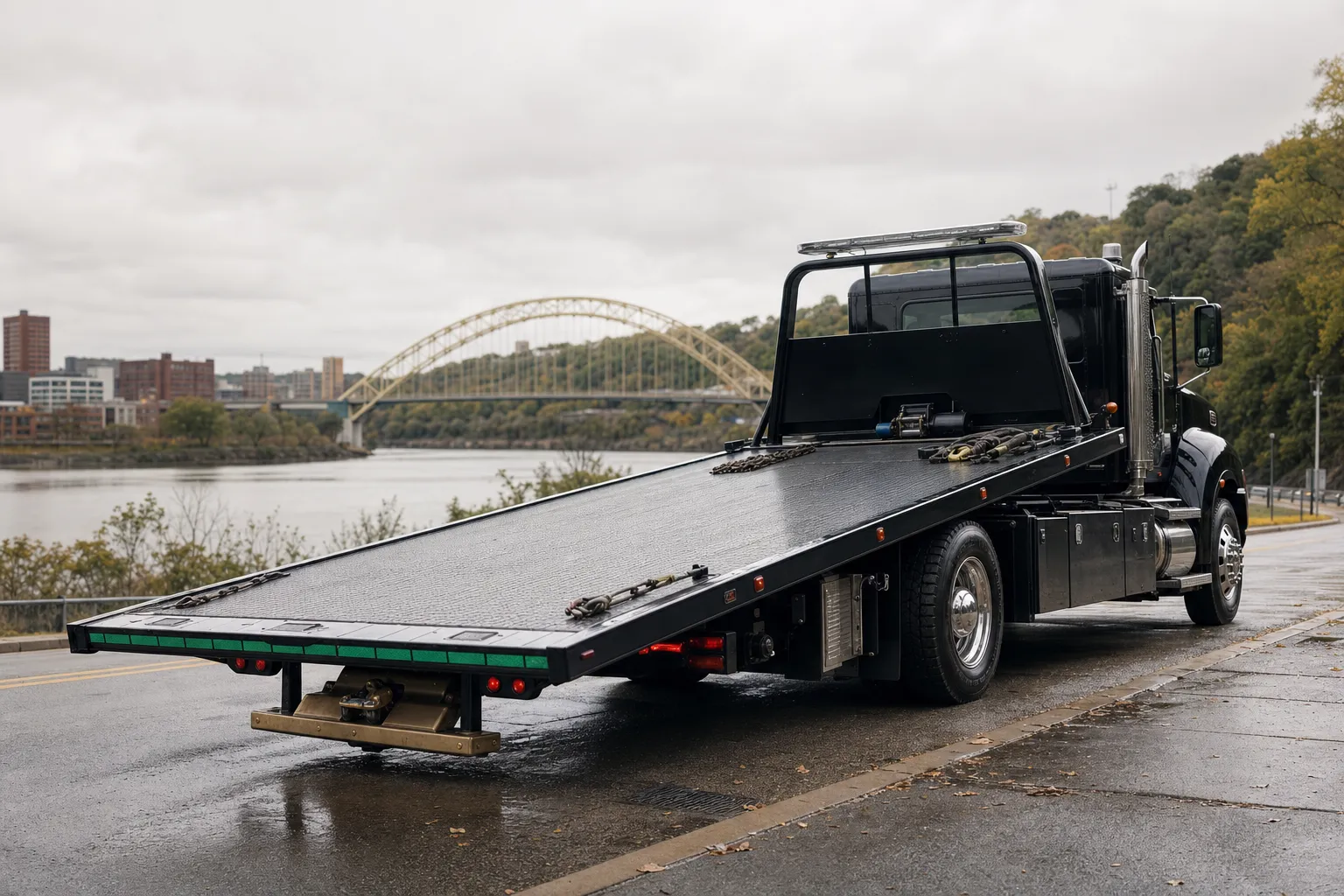
Before starting a tow, identify the right towing method for the vehicle and situation, confirm vehicle ownership and keys, evaluate safety and access at the scene, and plan for local road and weather conditions. At Tom Coop LLC Towing and Recovery we match equipment and operators to each job so vehicles are moved safely and with minimal disruption.
What types of towing are there
Towing covers a range of methods. Which method is right depends on the vehicle, where it is, how it is damaged, and how far it needs to go.
- Flatbed or rollback towing. The vehicle rides on a flat deck. This is the preferred option for all wheel drive cars, low clearance vehicles, show cars and most long distance moves.
- Wheel lift towing. A lift supports the front or rear wheels and tows the vehicle with the opposite wheels on the road. Wheel lift trucks are fast for short hauls and light duty use.
- Boom towing and recovery. A boom moves a vehicle from a difficult position such as over an embankment or on rugged terrain. We use booms when a vehicle cannot be towed by conventional methods.
- Dolly towing. A towing dolly lifts front or rear wheels off the road and is useful for short local moves when a flatbed is not available.
- Integrated towing. The truck combines the wheel lift and controls into one chassis. This is common for quick response and heavy light duty work for commercial fleets.
- Heavy duty towing and recovery. For larger vehicles and complex recoveries we deploy larger rigs and multiple anchors. This includes tractor trailer recovery and commercial equipment moves.
- Winch out service. When a vehicle is stuck off road or in a ditch, a winch out pulls it to stable ground so it can be loaded or driven away.
- Motorcycle towing. Motorcycles need special equipment and secure tie down to avoid wheel damage and instability during transport.
Why the choice of tow method matters in Pittsburgh
Pittsburgh has narrow streets, steep hills and many bridges. Those local conditions change how we approach a tow.
- Hilly neighborhoods such as Mount Washington and South Side require careful vehicle securing and sometimes a flatbed to avoid rolling and body damage.
- Downtown and the Strip District have tight curb space and loading restrictions. We plan access so we minimize disruption to traffic and businesses.
- Winter weather and road salt increase the risk of wheel and brake damage. That affects whether we tow on a flatbed or use a wheel lift.
- Highway incidents on I 376 or the Parkways often require fast scene control and coordination with first responders and property managers.
Key concepts to know before starting a tow
- Match the method to the vehicle. Low clearance, all wheel drive, hybrid or electric vehicles need different handling than light trucks.
- Vehicle condition matters. A stripped wheel, broken steering, or heavy underride changes how a vehicle can be moved safely.
- Ownership and authorization. Tow companies need proof of ownership or authorization from an owner or an agent before releasing a vehicle from storage.
- Securements and damage prevention. Proper tie down, wheel chocks and body support protect the vehicle during transport.
- Scene safety. Operators secure the scene to protect people and property, and to comply with local traffic rules.
- Storage and release. If short term storage is required we document condition and chain of custody carefully so release is straightforward.
Pre tow checklist
- Confirm vehicle location and access
- Confirm vehicle ownership or authorization
- Note keys and immobilizers
- Record visible damage and tire condition
- Choose the tow method that protects the vehicle and people on scene
How we decide which towing method to use
- Assess the scene. We evaluate vehicle position, damage, surrounding obstacles and traffic flow.
- Check the vehicle. We verify drivetrain, tire condition, parking brake status and whether the vehicle can roll safely.
- Pick the equipment. Based on the assessment we select a flatbed, wheel lift, boom or heavy duty rig.
- Stabilize and secure. Operators stabilize the vehicle and use the correct tie downs and chocks before moving.
- Transport and document. We transport the vehicle to the agreed location or secure storage and document condition for owner and insurance records.
We limit procedural detail so vehicle handling stays with trained operators. If you need a list of required documents or what to bring when you retrieve a vehicle, see related resources below.
Comparing common towing methods
| Method | When to use it | What it protects |
|---|---|---|
| Flatbed | Low clearance, all wheel drive, long distance, show cars | Undercarriage, drivetrain, body |
| Wheel lift | Short local moves, driveable vehicles, quick releases | Fast response, limited undercarriage protection |
| Boom | Recoveries from embankments or obstacles | Safe extraction from difficult positions |
| Winch out | Stuck vehicles in mud, snow or ditches | Prevents further vehicle damage during extraction |
Related services we provide
Beyond towing, these services are commonly needed at a scene or afterwards.
- Winch out service for stuck vehicles and recoveries
- Car unlock service for lockouts without damage to doors or locks
- Jump start service for battery failures on site
- Flat tire repair to get you rolling when the tire can be repaired
- Auto locksmith work for more complex key and lock issues
- Towing for local and long distance transport and secure short term storage
Related locations and where local factors change the job
We operate across Pittsburgh and nearby communities, and local conditions change how a tow is handled.
- Mount Washington and South Side require care for steep driveways and narrow streets
- Downtown and the North Shore need traffic control and attention to loading zones
- Highway incidents on I 376 or the Parkway need coordination with emergency responders
- For specific neighborhood guidance see our Pittsburgh location page at Tom Coop LLC Towing and Recovery in Pittsburgh
Helpful resources and further reading
Official guidance and statistics can help you understand the industry and what to expect.
- Towing overview on Wikipedia for background on towing methods and terminology
- Bureau of Labor Statistics data for tow truck drivers for employment and occupational details
- National Highway Traffic Safety Administration guidance for vehicle securement and highway safety practices
Key takeaway
Choose the tow method based on vehicle type, condition and access. In Pittsburgh planning for terrain, traffic and weather is part of the decision. Tom Coop LLC Towing and Recovery matches equipment and trained operators to each situation to protect vehicles and reduce disruption.
Frequently asked questions
What should I do before the tow truck arrives?
Make sure you have vehicle ownership documents or authorization, move personal items out of the vehicle if it is safe to do so, note obvious damage, and tell the operator about any keyless entry or immobilizer issues. Stay a safe distance from traffic if the vehicle is on a public roadway.
How do I know if my car needs a flatbed or a wheel lift?
Flatbeds are usually better for all wheel drive vehicles, low clearance cars, and long distance moves. Wheel lift is used for quick local moves when the vehicle can be towed without added undercarriage risk. The operator assesses vehicle drive type, clearance and damage to decide.
What happens if my car is stuck off road or in a ditch?
We use winch out service and boom equipment when a vehicle cannot be driven or towed conventionally. The priority is safe extraction and preventing additional damage. In complex recoveries we may stage additional anchors or heavier equipment.
Do you handle commercial fleet and dealer transport?
Yes. Tom Coop LLC Towing and Recovery works with commercial fleets and dealerships for routine transport, recoveries and short term secure storage. We can coordinate scheduling and handling to meet fleet needs.
What paperwork is required to release a vehicle from storage?
To release a vehicle owners or authorized agents must show proof of ownership and valid identification. If an insurance company is involved we work with adjusters and provide condition documentation on request.
How do local weather and Pittsburgh terrain affect towing?
Hills, bridges and winter road conditions affect how we secure and move vehicles. In snowy or icy conditions we prefer flatbeds when possible and add extra securements to prevent chain and wheel damage.
Where to learn more
Check our Google Business Profile to read customer reviews and get directions. To explore more topics and services on this site, see our collection of topics and our locations information pages for service area details and related guides.